
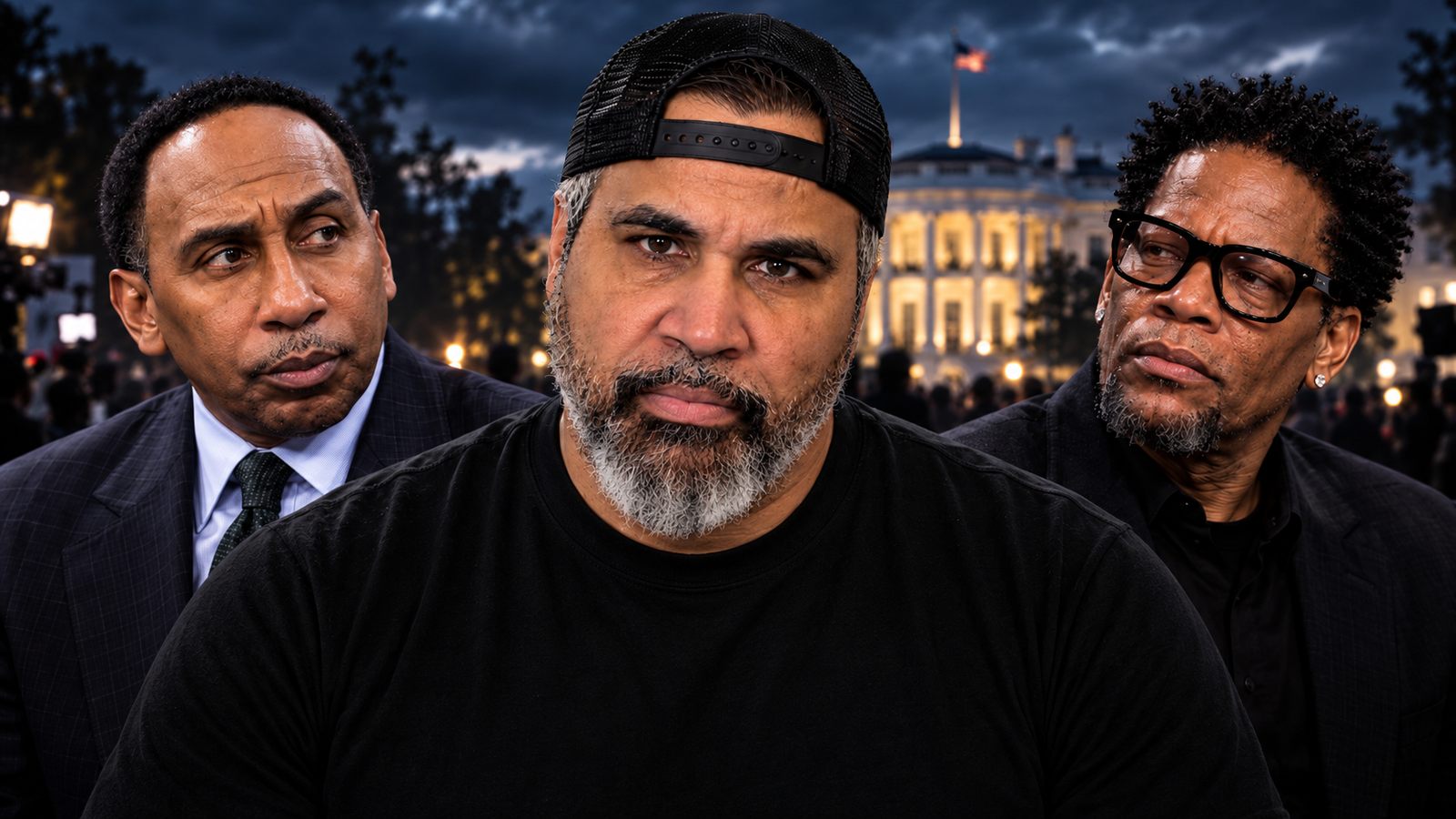
Why Are We Attacking People Trying to Help Black America?

How the hell are we supposed to make positive changes in the Black community when we criticize and attack the very people willing to try?
Seriously. Somebody explain that to me.
We complain about racism. We complain about inequality. We complain about unemployment, struggling neighborhoods, and the lack of opportunities available to Black Americans.
And then, when somebody gets an opportunity to sit down with the President of the United States and discuss those very issues, what do we do?
We attack him!
Apparently, having a conversation with somebody you disagree with is now considered a betrayal.
And if that's where we are as a country, we've got a much bigger problem than Donald Trump.
Why Stephen A. Smith's Meeting With Donald Trump Sparked Controversy
On October 15, 2026, ESPN commentator Stephen A. Smith attended a dinner at the White House with President Donald Trump, comedian Bill Maher, and musician Kid Rock.
Naturally, the backlash followed.
Among those criticizing Smith was comedian and political commentator D.L. Hughley, who questioned the purpose of the meeting and whether anything meaningful would come from it.
But here's what makes this entire situation so ridiculous.
Stephen A. Smith didn't claim he was going to the White House to become Donald Trump's newest cheerleader.
He says he used the opportunity to address issues affecting Black Americans, including unemployment and support for Historically Black Colleges and Universities (HBCUs).
Now, whether anything meaningful comes from that conversation remains to be seen.
But shouldn't we at least acknowledge the fact that he was willing to have it?
If we can't talk to the people who have the authority to make decisions, how exactly are we supposed to influence those decisions?
Are we supposed to stand outside the White House screaming that everybody inside is racist until something magically changes?
Is that the plan?
Because I'm genuinely curious how that's supposed to work.
When Did Being Offended Become More Important Than Being Effective?
Look, anybody who's followed The Mikerock Show knows where I stand on Donald Trump.
I voted for him. I've also made it perfectly clear why I would not vote for him again.
I've got serious disagreements with the man, and I'm not changing my principles simply because he happens to be the President of the United States.
But here's something that apparently needs to be said.
Disagreeing with Donald Trump doesn't mean I have to oppose every positive thing somebody might accomplish by working with him.
That's ridiculous.
My loyalty isn't to Trump.
My loyalty isn't to the Republican Party.
And it sure as hell isn't to the Democratic Party.
My loyalty is to the American people.
And that includes Black Americans who deserve the same opportunities, economic stability, quality education, and ability to build better lives as everybody else.
So if Stephen A. Smith gets an opportunity to discuss those issues directly with the President, why wouldn't I want him to take advantage of it?
What would we rather have him do?
Turn down the invitation, go back on television, and complain that nobody's doing anything?
Congratulations!
You stood on principle, accomplished absolutely nothing, and now everybody gets to go back to arguing on social media.
What a victory.
When did being offended become more important than actually getting something accomplished?
D.L. Hughley Has Every Right to Question the Results
Now, let me be fair to D.L. Hughley.
He has every right to question Stephen A. Smith.
He has every right to ask what was accomplished during the meeting.
And he has every right to demand accountability from people who claim they're advocating for the Black community.
In fact, I agree that those questions should be asked.
An invitation to the White House doesn't automatically make somebody a leader.
A photograph with the President isn't a policy change.
And sitting down for dinner doesn't automatically put food on a struggling family's table.
But there's a difference between demanding results and suggesting that someone shouldn't have pursued the opportunity in the first place.
That's where I draw the line.
If Stephen A. Smith uses his influence to advocate for HBCU funding, better employment opportunities, and other issues affecting Black Americans, shouldn't the focus be on whether those efforts produce meaningful results?
Why turn the conversation into another political loyalty test?
Because if we're going to judge people by what they accomplish, let's apply that same standard to everybody.
Not just Stephen A. Smith.
Not just D.L. Hughley.
Everybody.
How Can the Black Community Move Forward If We Discourage People From Trying?
This is what bothers me most about the entire controversy.
We're creating a culture where people are expected to choose between attempting to make progress and maintaining the approval of their own political side.
Think about how backwards that is.
We demand change.
Somebody attempts to create change.
We criticize the way they're attempting it.
And when nothing gets accomplished, we complain that nobody cares.
How the hell is anybody supposed to win in that situation?
More importantly, how is the Black community supposed to benefit from it?
We should be encouraging people with influence, resources, and access to advocate for their communities.
That doesn't mean giving those people a free pass.
It means holding them accountable for their actions without automatically condemning them for the conversations they're willing to have.
Because real leadership sometimes requires sitting across the table from somebody you don't particularly like.
Sometimes it means having uncomfortable conversations.
And sometimes it means putting the needs of other people ahead of your personal feelings.
That's not necessarily selling out.
That can be what leadership looks like.
Calling Out Racism Matters. But What Comes Next?
Let me make something perfectly clear before anybody starts twisting my words.
Racism is real.
Discrimination is real.
And when somebody is mistreated because of the color of their skin, that behavior absolutely deserves to be challenged.
But identifying a problem and solving that problem aren't the same thing.
Calling somebody racist doesn't automatically create a job.
It doesn't automatically improve a school.
And it doesn't automatically provide a struggling family with better economic opportunities.
Calling out injustice can be an important first step. Sometimes it's the very thing that forces institutions to act.
But eventually, somebody has to sit down and figure out what comes next.
What policies need to change?
Where are resources being wasted?
How do we improve education and employment opportunities?
And how do we hold the people responsible for those decisions accountable?
Those are the conversations that need to happen.
And refusing to participate simply because you dislike the person sitting across the table isn't going to make those problems disappear.
Political Loyalty Is Not Community Loyalty
One of the biggest problems in America today is that we've confused loyalty to a political party with loyalty to our communities.
Somewhere along the way, we started acting as though agreeing with a Republican makes you a Republican, and agreeing with a Democrat makes you a Democrat.
That's nonsense.
I can disagree with Donald Trump on a hundred issues and still support a decision he makes that's good for the American people.
I can criticize the Democratic Party while acknowledging when Democrats propose something worthwhile.
I don't have to surrender my ability to think independently just because somebody else demands political loyalty.
And neither does Stephen A. Smith.
You don't have to like somebody to work with them.
You don't have to agree with somebody to listen to them.
And you damn sure don't have to abandon your principles simply because you're willing to have a conversation with somebody who doesn't share them.
The question should always be whether that conversation is advancing something worthwhile.
That's the standard I'm interested in.
Not political affiliation.
Not personal popularity.
And certainly not who managed to offend the most people on social media.
Stephen A. Smith Deserves a Chance to Show Results
I'm not defending everything Stephen A. Smith has ever said.
I'm not defending Donald Trump.
And I'm not suggesting that attending a White House dinner makes somebody a hero.
What I'm defending is something much simpler.
The willingness to try should not automatically become a reason for condemnation.
If Stephen A. Smith can help bring attention to HBCU funding, Black unemployment, or economic opportunities that improve people's lives, then good for him.
I hope he succeeds.
And if nothing meaningful comes from his efforts, then we should be willing to ask why.
That's accountability.
But attacking someone simply because they're willing to engage with a political opponent isn't accomplishing anything on its own.
If anything, it risks discouraging the very conversations that might lead to progress.
The Real Question: What Are We Actually Accomplishing?
So let me bring this back to the question that started this entire conversation.
How are we supposed to do anything positive for the Black community when we're attacking the very people who are willing to try?
How are we supposed to bring Americans together when we treat conversations with the other political side as acts of betrayal?
How can we claim to want a better future for our children when we're more interested in winning political arguments than solving the problems those children are going to inherit?
Because here's what I believe.
The American people don't need more political cheerleaders.
We don't need more manufactured outrage.
And we certainly don't need more division disguised as leadership.
We need people willing to put aside their differences long enough to find common ground and get something accomplished.
That doesn't mean abandoning accountability.
It means making accountability about results rather than political loyalty.
And to those criticizing Stephen A. Smith simply for sitting down with Donald Trump, I've got one question.
If you don't like how he's trying to help, what are YOU doing differently?
Because if you've got a better solution, I'm all ears.
But if your only contribution is attacking people who are willing to have difficult conversations, then maybe it's time to reconsider whether you're helping solve the problem or contributing to it.
At the end of the day, we shouldn't judge people's commitment to their communities by who they're willing to talk to.
We should judge them by what they're willing to do, what they actually accomplish, and whether they're willing to answer for the results.
That's how we move forward. Not left. Not right. Together.
And that's the kind of common sense this country desperately needs.
I'm Mikerock, and I'm allergic to nonsense.
Join the Conversation
Do you believe Stephen A. Smith was right to meet with Donald Trump, or do you agree with D.L. Hughley's criticism?
More importantly, should we judge people by their political associations or by the results they produce?
Share your thoughts in the comments. Disagree all you want, but let's have a real conversation about solutions instead of just attacking one another.
Join us at PeoplesUSA.org, where we're working to bring The People together, find common ground, and turn conversations into positive action.
UNITED WE STAND.
